


By Stef Irish | Founder of True US Crime
A Killer Who Didn’t Hide
In the early 1970s, Northern California was gripped by fear. Young women students, hitchhikers, daughters began disappearing without warning. There was no clear pattern. No obvious suspect.
What made this case even more disturbing was not just the brutality of the crimes but the identity of the man behind them.
His name was Edmund Kemper.
And he didn’t run.
A Troubled Beginning
Edmund Kemper was born on December 18, 1948, in Burbank, California. From an early age, his life was marked by instability, conflict, and emotional isolation.
His relationship with his mother, Clarnell Strandberg, would later be described as deeply toxic. Reports indicate constant criticism, humiliation, and psychological control.
Kemper grew up feeling rejected, particularly by women.
And over time, that resentment evolved into something far more dangerous.


The First Murders: A Warning Ignored
At just 15 years old, Kemper committed his first murders.
He killed his grandparents:
- Edmund Emil Kemper II
- Maude Matilda Kemper
After the crime, he reportedly stated he wanted to know what it felt like to kill his grandmother and then killed his grandfather to spare him the pain of discovering her body.
He was arrested and sent to a psychiatric institution.
Years later, he was released.
Many would later question that decision.
The Return and the Escalation
By the early 1970s, Kemper was living in California again. On the surface, he appeared functional intelligent, articulate, even cooperative with local law enforcement.
But beneath that calm exterior, something had changed.
He began picking up young female hitchhikers.
They trusted him.
They got into his car.
They never came back.
The Victims
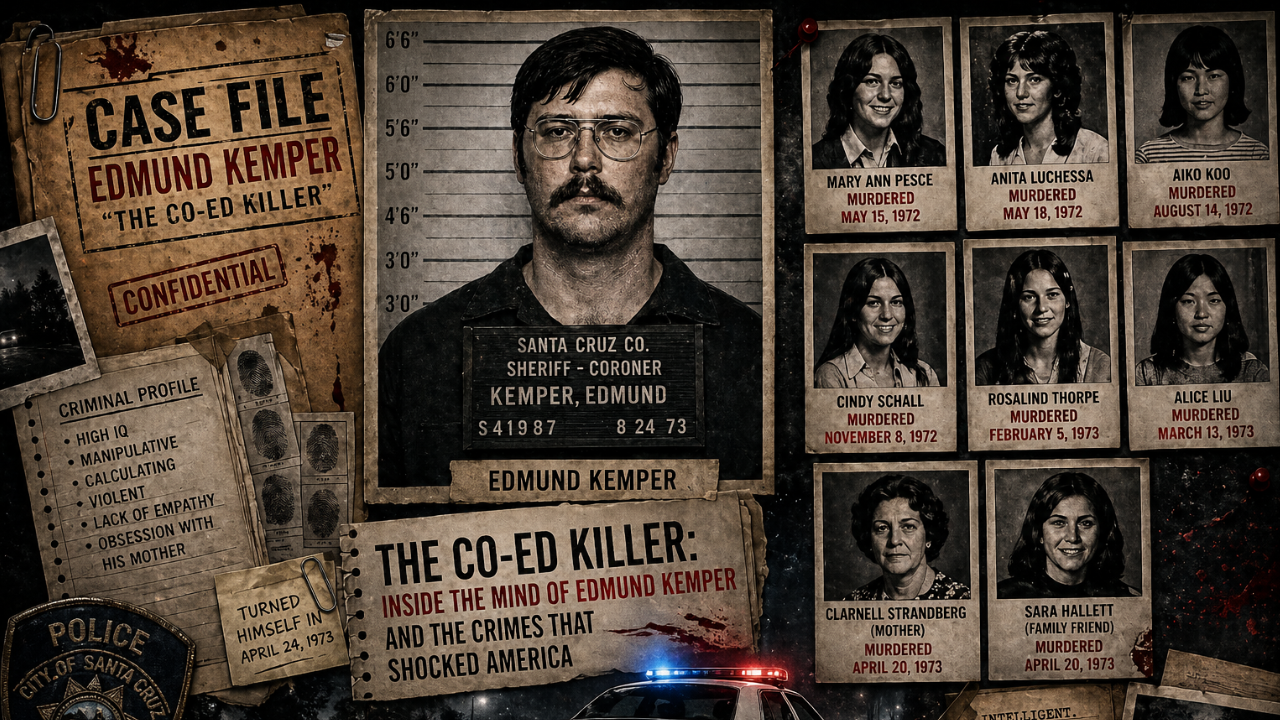
Between 1972 and 1973, Kemper murdered six young women:
- Mary Ann Pesce
- Anita Luchessa
- Aiko Koo
- Cindy Schall
- Rosalind Thorpe
- Alice Liu
Each victim was targeted, isolated, and killed with calculated precision.
These crimes earned him the nickname:
“The Co-Ed Killer.”
A Double Life
What made Kemper especially dangerous was his ability to blend in.
He was known to:
- socialize in bars frequented by police officers
- speak openly about criminal psychology
- discuss ongoing investigations
In some cases, he interacted directly with law enforcement while actively committing murders.
He was not hiding.
He was observing.

The Final Breaking Point
In April 1973, Kemper’s violence reached its peak.
He murdered his mother, Clarnell Strandberg.
For investigators and psychologists alike, this act became the key to understanding his motives.
Shortly after, he killed Sara Hallett, a friend of his mother.
Then, something unexpected happened.
The Confession
Kemper didn’t wait to be caught.
He turned himself in.
He called the police and calmly confessed to the murders detailing his actions with disturbing clarity.
At first, authorities didn’t believe him.
But he insisted.
And the evidence confirmed everything.
Inside the Mind of Edmund Kemper
Psychiatric evaluations revealed a deeply complex individual:
- exceptionally high intelligence
- extreme emotional detachment
- compulsive and violent fantasies
- deep-rooted anger toward his mother
Kemper demonstrated an unusual level of self-awareness. He understood his actions and could explain them.
That made him even more unsettling.
Sentencing and Life Today
Edmund Kemper was convicted of eight murders in 1973 (excluding the earlier killings of his grandparents, which had been adjudicated separately).
He was sentenced to life in prison.
Today, he remains incarcerated in California.
The Impact on America
The Kemper case had a lasting influence on criminal psychology and law enforcement.
Criminal Profiling
His interviews helped shape early FBI profiling techniques.
Forensic Psychology
Kemper became a key subject in understanding organized killers.
Public Awareness
The case revealed how easily a killer could appear normal and operate undetected.
Final Thoughts
Edmund Kemper was not just a killer.
He was a contradiction.
Highly intelligent.
Deeply disturbed.
Completely aware.
His story forces one uncomfortable question:
What if the most dangerous people are not the ones who hide but the ones who understand exactly who they are?
Researcher’s Note
This report was independently researched and written by Stef Irish, founder of True US Crime.
This article is the result of several months of in-depth research, combining historical records, verified timelines, and documented sources to ensure accuracy and clarity.
Particular attention has been given to investigative details, behavioral analysis, and the broader context surrounding the events, with the goal of delivering a clear, structured, and reliable account.
All content is developed with a commitment to factual integrity, professional storytelling, and respect for the individuals and cases explored.
This note applies to all investigative reports published on True US Crime, reflecting a consistent standard of research and editorial quality.


