


1. The Quiet Farm in La Porte
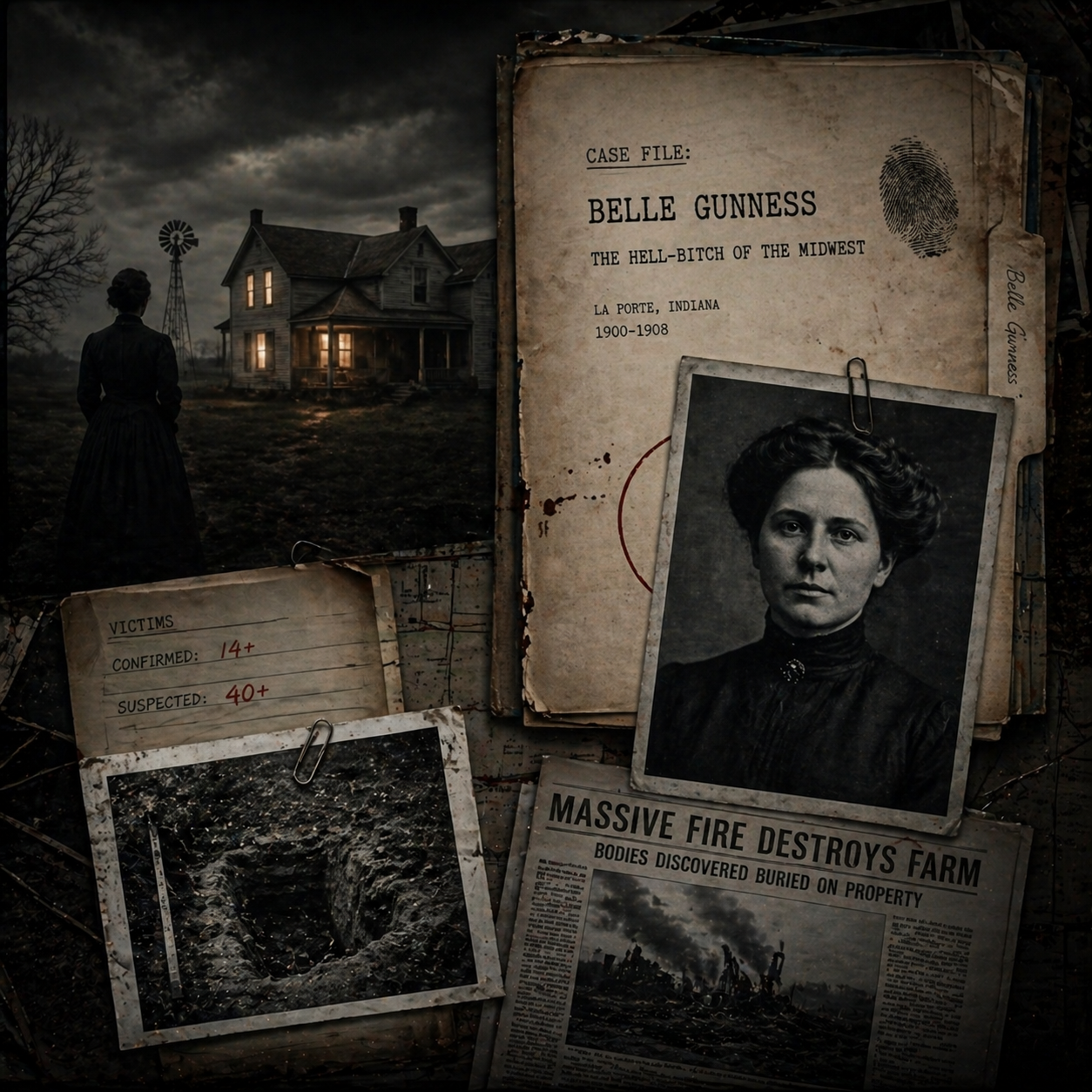
In the early 20th century, the rolling farmland of Indiana seemed like an unlikely stage for one of America’s most prolific serial killers. But nestled within this quiet landscape was the farm of Belle Gunness.
The Facade: To her neighbors in La Porte, Belle appeared as a hard-working, twice-widowed mother, struggling to raise her children. Standing at over six feet and over 200 pounds, she was physically intimidating but often perceived as simple and robust.
The Opportunity: For Belle, her farm was not for agriculture; it was an industry of profit, and the main product was death. Her chosen method was unique: using the lonely, vulnerable, and wealthy, drawing them to her home through the classifieds.
2. The Trap: The Fatal Love Letters
Belle’s masterstroke was the use of “Lonely Hearts” ads placed in Midwestern newspapers. Her letters were complex masterpieces of psychological manipulation, promising a life of companionship and wealth on her large farm.
The Bait: She wrote, “My heart beats with longing for a dear man of my own… You should not come unless you have money. I want some one who is going to make it happy.” This combination of emotional connection and financial requirement successfully filtered for wealthy victims.
The Prey: Men from all over the Midwest, carrying their life savings in cash, traveled to La Porte, Indiana. Once they arrived, they were isolated, and Belle’s meticulous, brutal plan commenced. None of them were ever seen alive again.
3. Forensic Analysis: The Butchery at La Porte
The horrific reality of the Gunness farm only came to light on April 28, 1908, following a catastrophic fire that consumed her home. When investigators sifted through the ashes, they didn’t just find the remains of Belle and her children; they discovered a charnel house.
- The Yard of Death: Hidden beneath vegetable patches and farm structures were the shallow graves of dozens of men. Most bodies were dismembered, with heads often missing, making identification nearly impossible in the pre-DNA era. The forensics of 1908 were basic, focusing on identifying personal items found near the remains.
- The Missing Signature: The most shocking discovery was that the body believed to be Belle was missing its head. Furthermore, the remains were far smaller than Belle’s known physical dimensions. This discrepancy launched the central, unsolved mystery of the case: was the victim really Belle Gunness?
4. The Final Deception: Simulating a Cold Case
The ultimate manipulation of the Black Widow of the Midwest was her final act.
The Great Escape Theory: The leading theory among investigators was that Belle, sensing her secrets were close to being revealed, had executed her final victim (a woman matching her size), started the fire to simulate her own death, and vanished with the fortunes of her murdered suitors.
The Vanishing Act: Numerous reports placed her in Chicago or California in the years following the fire, always a step ahead of the few who continued the search. Her case is one of America’s first true “Vanishing Cold Cases,” where the justice she deserved was perhaps never served.
Stef Irish’s Forensic Deep Dive
The Organized Serial Killer: Belle Gunness fits the modern profile of an extremely organized serial predator. She was a master of logistics, carefully managing the timing of her victims’ arrivals and the systematic dismemberment and disposal of bodies. Her operations required a specific level of pathological detachment and long-term planning, a chilling level of sophistication for a farmstead operator.
Psychological Warfare via Press: What interests me as a researcher is how she Weaponized the press of her day. It was not just for bait; she also used local news to present herself as a victim, complaining about neighbors or difficulties with her help, building a narrative that helped her operate undetected for years.
The Crime of Gender Identity: Belle often used the stereotype of the robust, simple farmwife to deflect suspicion. Authorities of 1908 often couldn’t conceive that a woman, particularly a “motherly” figure, was capable of such methodical, masculine violence and precise butchery. This societal blind spot gave her a license to kill. I have curated an extensive gallery of her correspondence on my Facebook and Twitter (X) pages to illustrate this deadly dual identity.

Researcher’s Note
This report was independently researched and written by Stef Irish, founder of True US Crime.
This article is the result of several months of in-depth research, combining historical records, verified timelines, and documented sources to ensure accuracy and clarity.
Particular attention has been given to investigative details, behavioral analysis, and the broader context surrounding the events, with the goal of delivering a clear, structured, and reliable account.
All content is developed with a commitment to factual integrity, professional storytelling, and respect for the individuals and cases explored.
This note applies to all investigative reports published on True US Crime, reflecting a consistent standard of research and editorial quality.


